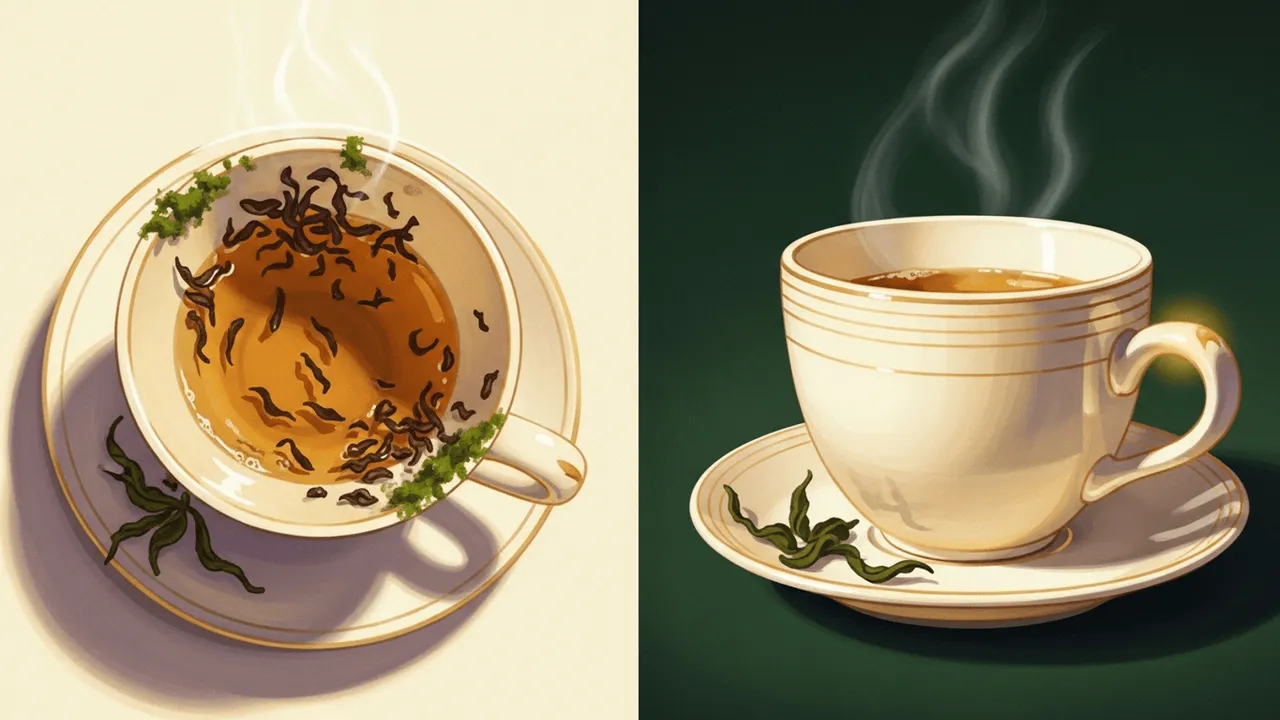
茶葉算命 · chá yè suàn mìng · leaf-reading
Tea-Leaf Reading
Tasseography is the reading of the shapes loose leaves settle into, and it has a living strand in the Chinese teahouse alongside its . It is simple and old, and the whole of it is below, step by step.
How to read a cup
Four small motions
- 1Drink the cup down to a last spoonful of liquid, leaves and all.
- 2Cradle it in your left hand and swirl it three times, clockwise.
- 3Turn it over onto the saucer and let it drain for a breath.
- 4Lift it and read what clings, by where the leaves have settled.
Twisted, half-oxidised leaves that open slowly. A brew for questions that turn on more than one thing.
Tasseography reads open questions best. Name what is on your mind, or leave it blank and let the leaves wander where they will.
Where a shape sits
The four places of the cup
The cup is read by place, not just by shape. The same symbol means one thing near the rim and another in the dregs, because the cup is a little map of time, near to far, top to bottom.
The handle
you, and your home
Everything is read in relation to the handle: it stands for you and the people under your roof. A shape near the handle touches your own life directly; the farther from it a shape sits, the farther from home its matter lies.
The rim
the days just ahead
The lip of the cup, where the tea last touched, speaks of the soonest things, the next few days. Leaves clinging high and near the rim are matters already in motion, close enough to act on this week.
The sides
the coming weeks
The slope down from rim to base is the middle distance, the weeks ahead. A shape on the side is a matter still forming, not yet urgent, worth keeping an eye on as it gathers.
The dregs
the months, and the deep currents
The pool at the bottom holds the long view, the months out and the undercurrents beneath the surface of things. Heavy dregs are the slow, weighty matters; a clear base is a road that runs open for a while.
Reading the motion
Direction, nearness, and touch
Direction. Read around the cup from the handle. A shape clockwise of the handle is approaching, coming toward you; one counter-clockwise is passing away, on its way out of your life.
Nearness. The closer a shape sits to the handle, the closer its matter is to you and yours. A figure on the far side of the cup concerns people or events at some remove.
Touch. Two shapes that touch make a small story your eye can trace, a bird beside a letter, a coin beside a road. Let the pair tell its sentence before you reach for the dictionary of single symbols.
None of it is a settled fate. The leaves offer a shape for your own thinking, and the choosing always stays yours.
A creature in the cup? Read the tea-animal meanings, or brew the leaf with the tea ceremony timer.