
I Ching
The Book of Moving Water
There is a book older than almost any book you have held, and it does not tell you what will happen. It tells you what is happening, the shape of the water you are standing in right now, and then it tells you the water is moving. The I Ching, the Yijing, the Book of Changes. You come to it with a question and a few coins or a handful of dried stalks, and it hands you back a picture made of lines.
Two kinds of line
Everything in this book is built from two marks. A solid line, unbroken, called yang. A broken line, a gap in the middle, called yin. That is the whole alphabet. One is open, one is firm, and neither is better than the other, the way the field that accepts the snow is not lesser than the dragon that climbs the sky.
Stack three of these lines, bottom to top, and you have a trigram. There are eight of them, eight small weathers, and they carry the oldest names in the book. Heaven, all three lines solid. Earth, all three broken. Then thunder, water, mountain, wind, fire, lake, the family of forces that the world is made from. You can feel them in the images the book keeps returning to, the cloud above heaven, the mountain resting on the earth, the lake without water.
Sixty-four rooms
Now set one trigram on top of another. Two trigrams, three lines each, six lines in all, and you have a hexagram. Eight times eight makes sixty-four, and sixty-four is the size of the whole book, sixty-four rooms you can walk into.
Each room has a name and a feel. The first is The Creative, six solid lines, six dragons rising. The second is The Receptive, six broken lines, the field that carries everything. Between them sit the others, plainspoken and strange. Waiting. Conflict. The Well, where the town moves and the well does not. After Completion, where the task is done and the table is wiped and the next task is already arriving. Before Completion, the young fox almost across the stream, its tail gone wet. The order they sit in is called King Wen's order, the arrangement attributed to the old king who is said to have set them down while imprisoned, and it is the order you will meet them in still. You can wander all sixty-four in the I Ching tool, one stacked picture at a time.
How you ask
You do not just read this book, you consult it. The old way is yarrow stalks, fifty dried lengths of a tall plant, sorted and counted and set down again through a long quiet ritual that builds your six lines one at a time from the bottom up. It is slow on purpose. It makes you sit with the question the way you would sit with a candle.
The quick way is three coins. You toss them, you read heads and tails as small numbers, you add them, and the sum tells you whether that line came up yin or yang, solid or broken. Six tosses, six lines, a hexagram rises out of your hand. If you would rather let the coins fall here, there is a coin toss that keeps the count for you.
The changing lines
Here is the part that makes it the Book of Changes and not the Book of Fates. Some of the lines you draw come up still, and some come up moving, ready to flip. A moving yang becomes yin, a moving yin becomes yang, and when they turn, your first hexagram becomes a second one. So you are handed two pictures, the situation as it stands and the situation as it is already becoming. Splitting Apart loosens into Return. The seed remembers itself in the dark. Nothing it shows you is a wall, it is all river, and the changing lines are where it points to say, this part of you is already on its way somewhere.
That is the gift of it. You do not get told the ending. You get told the weather, and where the wind is leaning, and then it is yours to walk into.
1701
The hexagrams Leibniz studied
The arrangement of the sixty-four hexagrams that the Jesuit Joachim Bouvet sent to Gottfried Leibniz, who saw in it his own binary arithmetic.
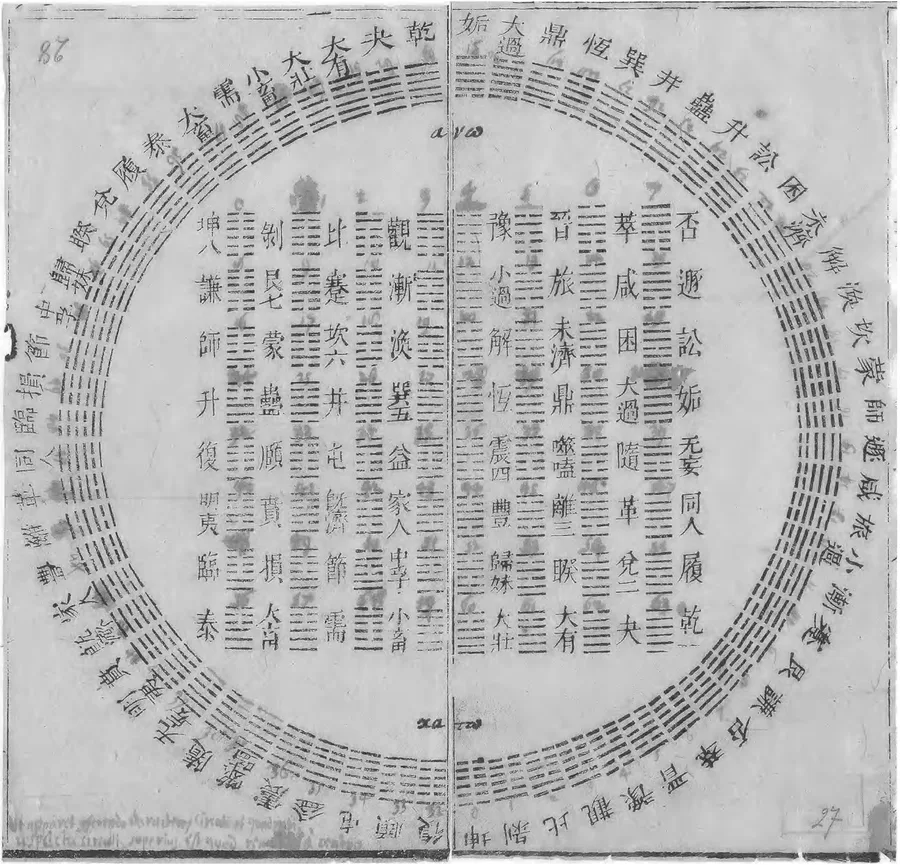
Diagram owned by Gottfried Wilhelm Leibniz, 1701. Public domain (via Wikimedia Commons).
Sit with whatever picture comes up. Read the still lines as the ground under your feet and the moving lines as the water already pulling at your ankles, and remember the book is not promising you anything. It is only describing the moment honestly, the way a friend would, and then leaving the next step in your hands.