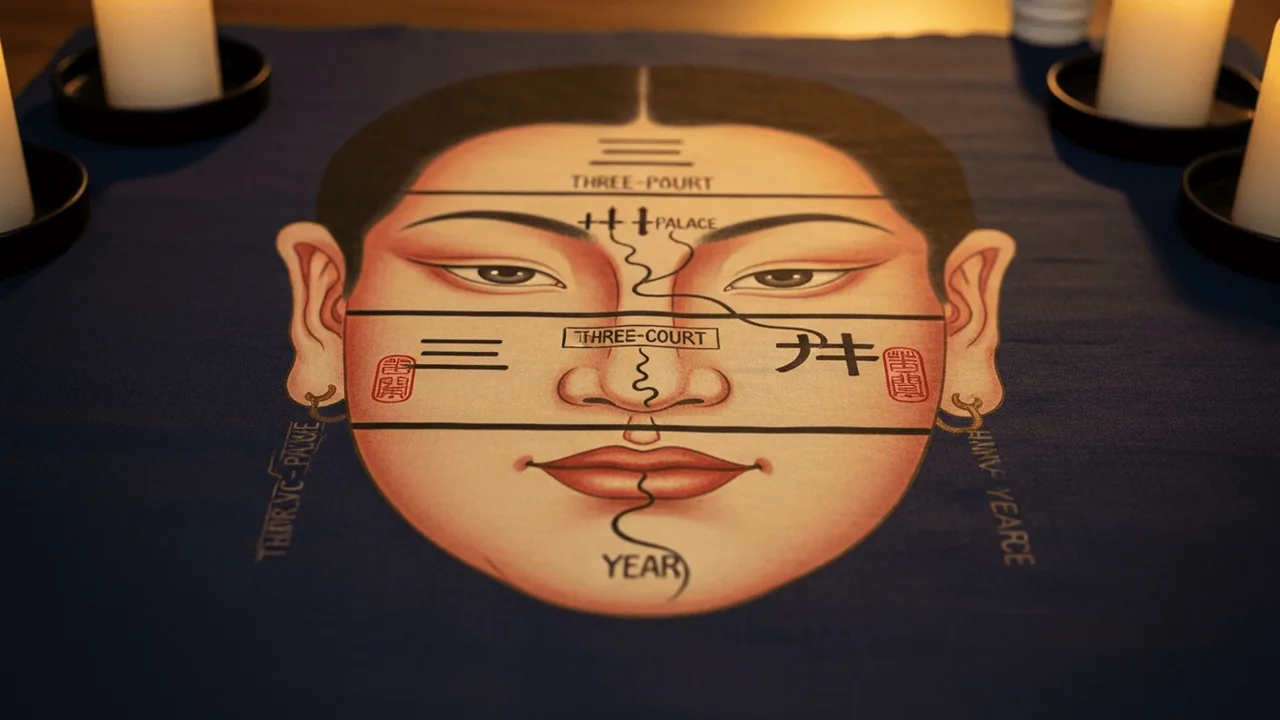
面相 · miàn xiàng · the face that already speaks
Physiognomy
Mian Xiang is the Chinese art of reading the face, a branch of the old xiang shu (相術), physiognomy, descended from the Ma Yi Shen Xiang manuals of the Song dynasty. Every other oracle in this room casts something from outside the body, bones crack, blocks tumble, sticks shake. Face reading casts nothing: the oracle is a face that already exists. So you build one. Region by region you choose the named form nearest each feature, the way the old manuals catalog them, a phoenix eye, a gallbladder nose, a Buddha ear, and the bones of that composed face speak the seasons of a life through the Three Courts (三停), the Five Officers (五官), and the Twelve Palaces (十二宮). A single point on the Hundred-Year map lights on your age and reads this year. Build the same face with the same birth and it reads the same, every time. This is a symbolic map of feature-types, never a photo and never a judgment of any living face. It shows the weather of the seasons and leaves the walking of them to you.
A symbolic face, never a photo. Pick the named form nearest each feature.
Sets the year-stamp and the point your years rest on. Optional.
Forehead額Upper Court
The upper court, the heaven of the face. It carries early life, the mind, and what your line handed down.
Brows眉Upper Court
The brows are the Guardian among the Five Officers, the canopy over the eyes. They hold temperament, siblings, and the years thirty-one to thirty-four.
Eyes眼Middle Court
The eyes are the Inspector, the chief of the Five Officers, the window of the spirit (shen 神). They hold vitality and the years thirty-five to forty.
Nose鼻Middle Court
The nose is the Judge among the Five Officers, the ridge that rules the middle court. It holds wealth, the self, and the years forty-one to fifty.
Ears耳Upper Court
The ears are the Gatherer, the first of the Five Officers, ruling the earliest years, one to fourteen, and read for wisdom and long life.
Mouth and chin口Lower Court
The mouth is the Steward, the last of the Five Officers, ruling speech, appetite, and late fortune, the years fifty-one to sixty. The chin closes the lower court and the years beyond.