Opening your page…
Once you've started watching the moon, the cards start landing on her schedule. You'll pull something soft on a waxing crescent and something hard on a full moon and something quiet on a dark moon, and after a while you'll stop being surprised. The moon makes the deck specific. The deck makes the moon felt.
Here are five practices, one for each phase, that I've come back to for years. Each takes under fifteen minutes. Each is small enough that you'll actually do it.
The new moon intention pull. New moon is the slim crescent, the moon barely there. The energy is beginning, but tentative — not the loud start of "new year, new me," the soft start of "what if." Sit down with one candle. Shuffle. Ask: "what wants to be planted this month?" Pull one card. Don't argue with it. The new moon answers in seeds, not blueprints. If the Three of Pentacles comes up, the seed is collaboration — find someone to build with this cycle. If the High Priestess comes up, the seed is listening — make space to hear something you've been talking over. Write the card and the seed in one sentence on a small piece of paper. Fold the paper. Put it somewhere you'll find it at the next new moon. Don't reread it in between. The seed knows what it's doing underground.
The waxing moon momentum pull. The moon is growing now, from crescent to gibbous, the light getting steadier each night. The energy is forward, but not all-out. This is the phase where the new moon's seed wants water and small care, not heroics. Halfway through the waxing — about a week after the new moon — do a two-card pull. First card: "what's already growing." Second card: "what does it need this week." The first card is for noticing — the new moon planted something and it's coming up somewhere you may not have looked. The second card is the action. If the second card is a Page, the action is curious and small. If it's a Knight, the action is moving. If it's a Pentacle, the action is physical, repeatable, dailyish. Do the action that week. Don't overthink it.
The full moon reckoning pull. Full moon is the loudest phase. Light spills into the rooms of your life that have been dark for two weeks. People cry on full moons, fight on full moons, end things on full moons, start things on full moons. Don't fight the loud. Use it. Do a three-card pull with these positions: what is full, what is illuminated, what is asking to be released. The first card is the harvest — the thing that's ripe right now, ready to be acknowledged. The second card is the secret — the thing the bright moon is showing you that you'd been not-seeing. The third card is the cut — the thing this cycle is asking you to leave behind so the next cycle has room. Don't act on the third card immediately. Acting on the full moon often backfires; the energy is too bright for clean choices. Just name what wants to be released. The waning moon will do the work.
The waning moon release pull. The moon is shrinking now, from gibbous back toward crescent, the light going out a little each night. The energy is honest about endings. This is the phase for the harder readings — shadow work, grief, the thing you've been avoiding. Halfway through the waning — about a week after the full moon — sit down with the card the full moon told you to release. Put it face-up on the table. Pull two cards around it. Left card: "what made this hard to release." Right card: "what becomes possible when it's gone." The left card is for tenderness — the thing you were holding wasn't being held for no reason. The right card is for the after. Read them slowly. Then, if you want, put the face-up card back in the deck face-down, shuffle, and let the deck eat it. The ritual is small but it lands.
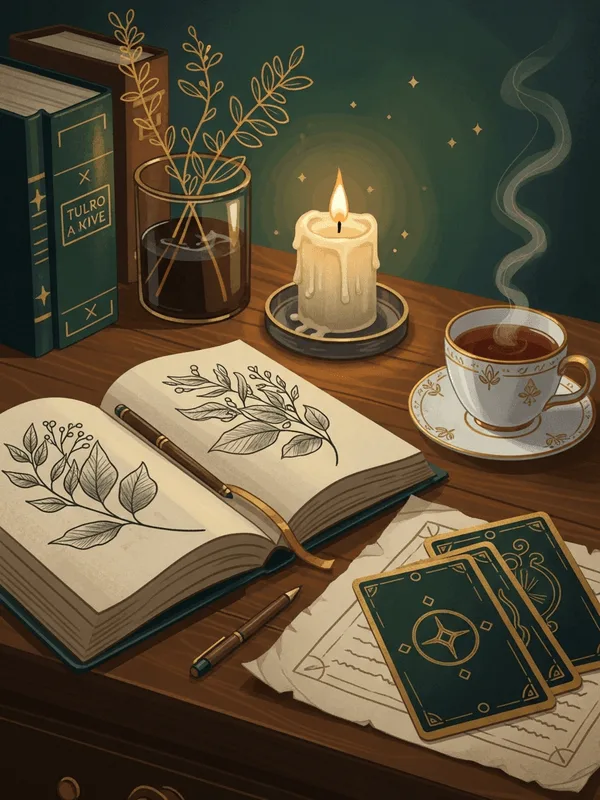
Keep a small notebook just for moon pulls. Date each entry with the phase, not the calendar date. After a year you'll have a record that reads in cycles instead of weeks, and the patterns will be visible in a way they aren't in a daily journal.
Don't worry about getting the exact moment of the phase right. The energy lasts longer than the precise hour the moon turns. Within a day of the new moon, within a day of the full, you're in the energy.
If you miss a phase, don't make it up. The moon will come back next month. The practice is not a streak. The practice is a returning.
The moon was already going to go through her phases this month. The cards just give you a place to sit inside them.